SUBSCRIBE for Upcoming Course Announcements
Test yourself with this week’s ECG case. Then scroll down for a structured step-by-step interpretation and clinical pearl.
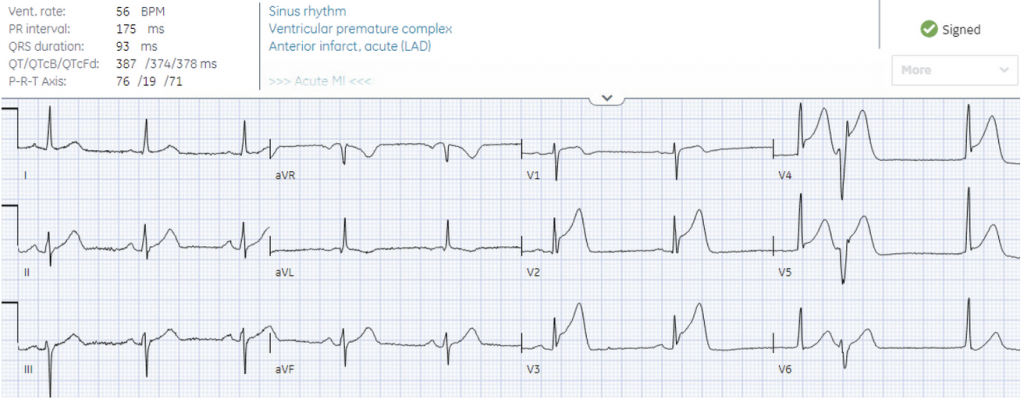
A 70 year old presented with acute chest pain.
The final interpretation says acute LAD infarct based on anterior ST elevation. What are other signs of occlusion, and why is there no inferior reciprocal change?
–Heart rate/rhythm: sinus brady with PVC
–Electrical conduction: normal intervals
–Axis: normal
–R-wave progression: early
–Tall/small voltages: normal
–ST/T changes: primary ischemic STE and hyperacute waves V2-5, terminal QRS distortion V3, excess discordant STE in V4 PVC, subtle inferior STD reciprocal to STE in V1. There is no inferior STD and instead possible hyperacute T waves in II/aVF STE
Acute mid LAD occlusion
There can be multiple signs of LAD occlusion involving the QRS-ST-T, including STD V6 reciprocal to V1 (precordial swirl). But LAD occlusions beyond the first diagnonal will not produce inferior STD, and may instead have inferior STE/hyperacute T waves.